

James webb space telescope Nedir?
Bu madde, sayarbilgi kavram dizini kapsamında hazırlanmış bir sözlük incelemesidir.
James Webb Space Telescope
James Webb Space Telescope (JWST) is a sophisticated space telescope designed to conduct infrared astronomy. As the largest telescope currently in orbit, it is equipped with high-resolution and high-sensitivity instruments that allow it to observe objects too old, distant, or faint for the Hubble Space Telescope. This capability enables extensive investigations across various fields of astronomy and cosmology, such as the observation of the first stars, the formation of the first galaxies, and the detailed atmospheric characterization of potentially habitable exoplanets.
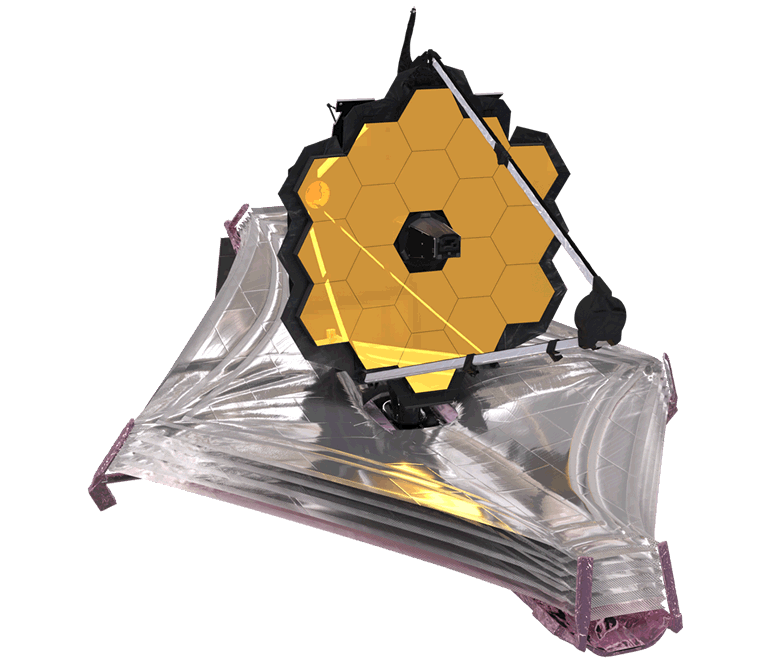
Despite its mirror being 2.7 times larger than that of the Hubble Space Telescope, Webb produces images of comparable resolution because it operates in the infrared spectrum. Infrared radiation has longer wavelengths than the visible spectrum observed by Hubble; consequently, a larger information-gathering surface—such as larger mirrors for infrared or larger antenna areas for millimeter and radio ranges—is required to achieve high resolution at those wavelengths.
Technical Specifications
The telescope’s primary mirror consists of 18 hexagonal segments made of gold-plated beryllium, which together create a 6.5-meter (21 ft) diameter surface. In comparison, the Hubble Space Telescope features a 2.4-meter (7 ft 10 in) mirror. This design provides Webb with a light-collecting area of approximately 25 m² (270 sq ft), which is about six times that of Hubble.
While Hubble observes in the near ultraviolet, visible, and near infrared spectra (0.1–2.5 μm), Webb focuses on a lower frequency range, spanning from long-wavelength visible light (red) through mid-infrared (0.6–28.5 μm). To ensure that the infrared radiation emitted by the telescope itself does not interfere with the collected data, the instrument must be kept extremely cold, below 50 K (−223 °C; −370 °F). A five-layer sunshield is utilized to protect the equipment from the heat of the Sun, Earth, and Moon.
Development and Mission
The project was a collaborative effort led by the U.S. National Aeronautics and Space Administration (NASA), in partnership with the European Space Agency (ESA) and the Canadian Space Agency (CSA). The NASA Goddard Space Flight Center managed the telescope’s development, while the Space Telescope Science Institute operates the facility. Northrop Grumman served as the primary contractor for the project.
Initial designs for the telescope began in 1996 under the name Next Generation Space Telescope. Following a significant redesign in 2005 and years of exhaustive testing, construction was completed in 2016 at a total cost of approximately $10 billion.
The telescope was launched on December 25, 2021, via an Ariane 5 rocket from Kourou, French Guiana. It reached its destination—a solar orbit near the Sun–Earth L2 Lagrange point, approximately 1.5 million kilometers (930,000 mi) from Earth—in January 2022. The first images were released to the public on July 11, 2022.
The telescope is named in honor of James E. Webb, who served as the administrator of NASA from 1961 to 1968 during the Mercury, Gemini, and Apollo programs.
Görsel Kaynağı: Wikimedia Commons